My blog has moved!

You should be automatically redirected. If not, visit
http://www.micheleguieu.com/wordpress/inspiration/
and update your bookmarks.

Pages

Showing posts with label movies books music radio. Show all posts

Wednesday, August 10, 2011

Dear Friend


Bright day with Ivan Sigg and his family at the house last week-end, visiting from Paris via San Francisco. Ivan brought us some treasures from France: a colorful poster he created with artist friend Eric Meyer, two books of enigmas he illustrated: Enigmes Litteraires Spectaculaires and Enigmes Litteraires Extraordinaires, and a novel: "Chroniques de l'Oiseau a Ressort" by Haruki Murakami (The Wind-Up bird Chronicle).
And yesterday, we received a wonderful letter in a beautiful envelope!

Saturday, January 29, 2011

Vertigo, San Andreas fault line, Cacti and Candles


The San Andreas fault line passes under...
these stairs (perpendicular to the ramp)


A drum recorder seismograph in the mission,
recording the activity of the fault
24/7


A statue of St. John the Baptist by sculptor Tom Marsh


Mission San Juan Bautista
406 Second Street

San Juan Bautista, CA 95045

Thursday, January 13, 2011

"Listening to Film Sound" Mark Berger @ Stanford University


photo copyright © El WRay

I was at Stanford the other night, listening to Mark Berger talking about the sound in movies.
Berger has an impressive list of credits including:
Capote (2005 / re-recording sound mixer)

The Royal Tenenbaums (2001 / sound re-recording mixer)

The Talented Mr. Ripley (1999 / sound re-recording mixer)

Playing by Heart (1998 / sound re-recording mixer)

The English Patient (1996 / sound re-recording mixer)

The Scarlet Letter (1995 / supervising re-recording mixer)
Catch Me If You Can ( 1989 / supervising re-recording mixer)
Blue Velvet (1986 / re-recording mixer)

Amadeus (1984 / supervising rerecording mixer)

The Right Stuff (1983 / supervising re-recording mixer)

Apocalypse Now (1979 / sound re-recordist)
Invasion of the Body Snatchers (1978 / supervising re-recording mixer)
One Flew Over the Cuckoo's Nest (1975 / post-production sound director)

The Godfather: Part II (1974 / sound montage associate)
Wheels of Fire (documentary) (1973 / supervising re-recording mixer)

He teaches at Berkeley.

He presented some scenes from "The Talented Mr Ripley", "Playing by Heart" and "Apocalypse Now" and talked about the dialogues, the music and the effects.
We saw each scene with the complete sound, and then with only the music, the dialogues, the effects or the Foley. Very interesting!

It took three years to make the soundtrack of Apocalypse Now. With the creation of a complete library of sounds of all the weapons used in the Vietnam war, which meant spending lots of time "embedded" with the U.S. army to record all the different sounds in different bases in the U.S. Because the latest sounds of the war "available" before "Apocalypse Now" dated from WWII.


In a certain scene where one wooden bridge explodes, he and his team came up with a sound "embedded" inside the sound of the explosion: they added the sound of a bowling ball rolling into a set of pins and then changed the pace and the frequency of the sound. In the scene, it gives a great sound of wooden planks "exploding". There are plenty of "embedded" sound in the "normal sound" - like the sound of a roaring lion mixed with the sound of the twister in "Twister".


In another scene, when Berger made us hear the dialogue alone, one can hear that young guy saying "I'm not going, I'm not going, I'm not going" as the helicopter he is in lands. In the full version, with all the sounds (dialogues, music and effects), one cannot hear what he says, one can only see the horror in his eyes while he is screaming in direction to the camera. Berger talked about the fact that this detail alone was really important in the movie, the young recruit, drafted, who does not want to be there, who does not want to die.


And as someone in the audience was asking why so many things are not "audible" in the full audio version, Berger was saying that one could tell something was wrong if all the sound were not there, but when they are and you don't seem to hear them, in fact you do, it is there, underneath.


Berger talked about subtlety in a context where you least expect it: a movie about a war. But the demonstration was brilliant and his work, indeed subtle.
He was saying that Coppola was very demanding in term of depth for the action: the most important action surrounded by all sorts of things going on at the same time. And you have to have sounds for all of that too. Even if in the end you do not hear much, it is there. The action is layered, so is the sound.

Berger asked "What did the digital era fundamentally change?" to the audience (students for the most part). Many responses but not the one he was looking for. So he said "what fundamentally changed is the possibility to postpone making decisions." he explained that before the digital era the changes were "physical", you actually had to cut the track and glue it/re-glue it. Now with the digital process, you can keep pretty much everything until almost the end of the process, which means the people who take care of the final mixing have more and more decisions to make. You can have hundreds of soundtracks still there.


It was really intriguing and fascinating to see the different scenes Berger analyzed for us, each time with one different component and in the end with all the components together.
He said we would never experience a movie the same way after the talk/screening. And I think it is true. He gave me some keys to "listen" to a movie more carefully, at least when I am enjoying a good sound system in a theater.

I recorded the first 45 minutes of the talk / screening.
Here are the three clips:


Mark Berger - audio clip #1 (14 minutes)


Mark Berger - audio clip #2 (14 minutes)


Mark Berger - audio clip #3 (14 minutes)

Listening to Film Sound: Screening, Lecture, and Q&A with Mark Berger
Tuesday, January 11, 2011. 7:00pm.
Approximate duration of 2.5 hours.
Stanford University / Cubberley Auditorium (Map)
Contact 650-723-3404
risip@stanford.edu
Admission: Free /open to the public

Tuesday, January 11, 2011

Golden Gate Bridge - Post # 500


The Golden Gate Bridge from Conzelman Road

(Golden Gate recreation area)


This is the post #500! Just a number, but I like it!

I started this blog March 13, 2008.

Drew Snyder's article "Michele Guieu's Defragmentation" was published in the printed edition of the San Diego Union Tribune. Which is great, only a few blog posts are published in the paper. Bravo Drew!
Saturday I am taking "Defragmentation" down. The five weeks went fast, I've got very good - and interesting - feedback. We'll see what happens next.


Just started a new class in the Video Arts Department, with the same teacher I had last semester, R.J. Ward. Online again.
The class is "Digital Video Production", with the same easy-to-use interactive website: announcements, assignments, tests and surveys, discussion and private messages, chat room, syllabus. I really enjoyed "Digital Video Editing", during which I got to work on three projects: re-editing a scene of Million Dollar Baby, making a short documentary and working on a "detournement". The Second part of that class is scheduled for September.

I finally met R.J. Ward, we had a coffee and it was great to have a conversation person to person! He is very knowledgeable, funny and passionate about what he is doing.


Saw some powerful movies including black and white autobiographical animation "Persepolis" by Vincent Paronnaud and Marjane Satrapi, the brutal and riveting "A Prophet" by Jacques Audiard. Also the recent "The Fighter", by David O. Russell, a boxing drama based on a true story - but above all a portrait of a dysfunctional family.


I loved "La Carte et le Territoire" (The Map and the Territory) by French author Michel Houellebecq. The book is about Jed Martin, an artist living in Paris who destroys his last painting (about Koons and Hirst), becomes famous by photographing large-scale Michelin maps, have a Russian girlfriend, a bitter and ill father, and meets... Michel Houellebecq.
It's cynical, funny, bleak and beautiful. Since I read his first novel "Extention du Domaine de la Lutte" (Whatever) in 1994 when it was published, I am very interested in that controversial - an not very correct - writer. “La Carte et le Territoire” received the Prix Goncourt in November 2010.


Monday, November 22, 2010

Tis the season


Last week at school (4th grade): owl pellet dissection


Sunday

Sunday, June 27, 2010

Summer Salon Series at the San Diego Museum of Art - Judith Pedroza - some photos of the event


Last Thursday, June 24, Judith Pedroza, Michael Trigilio, Lorraine Graham and Mark Wallace were invited to the SDMA for a special night. Music, readings, installation, workshop: another creative/energetic/ surprising session on the occasion of the "Summer Salon Series", every Thursday at the museum during the summer 2010. Thanks to the creators of this cool concept, Alexander Jarman (manager of public programs at SDMA) and David White (Agitprop).


Installation on the second floor

This Thursday, do not miss Richard Gleaves' Dark Room and Artist Confessional with Chris Warr.


Justin Morrison


Michael Trigilio


Michael Trigilio and Justin Morrison


workshop


The San Diego Museum of Art / Summer Salon Series
1450 El Prado, Balboa Park
San Diego, CA
(619) 232-7931

Free with Museum Admission

Monday, June 21, 2010

Here Not There: Performance Evening


This energizing and intriguing event took place Saturday, June 19 at MCASD La Jolla.


First time I've heard Tristan Shone. I was hypnotized. I missed some performances in the museum that night because I forgot about the time, listening to his massive and haunting music, disturbing at times. Fabulous setting on the patio overlooking the metallic ocean at dusk.


Brian Black and Ryan Bulis played ping pong in this long plastic bubble for more than four hours
in a row.


Agitprop (David White) interviewed some Agitprop's neighbors (North Park) next to some of the pieces in the show "Here not There". The interviews will be available for the public to listen to when they look at the pieces.


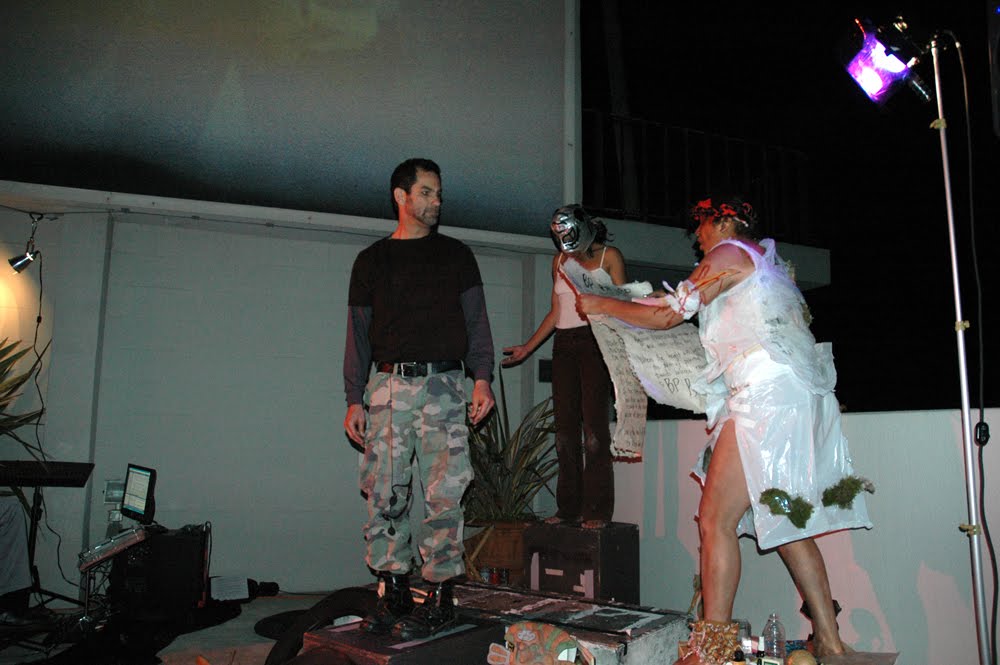
The Border Corps told us a tale of death and spirits about the U.S-Mexican border. Starting inside the museum and continuing outside in the dark, with projections and guitar live played by Anthony Vasquez. With the sound of the ocean in the background.


Perry Vasquez, Shondra Dawson, Endy


Performances by: Agitprop, The Border Corps, Brian Black and Ryan Bulis, Micha Cárdenas and Elle Mehrmand, Electronic Disturbance Theatre/b.a.n.g. lab, Brian Goeltzenleuchter, Wendell Kling, Ingram Ober, and Tristan Shone.

Here Not There: San Diego Art Now
MCASD La Jolla
Jun 06, 2010 through Sep 19, 2010