Wednesday, September 8, 2010
The Sheep Fire in Kings Canyon National Park
Videotaped Monday, September 7, 2010, from the road and next to the Kings River. This is an ongoing and controlled slow paced fire, which started by lightning on or around July 16. As of September 7, the Sheep Fire has grown to 3915 acres; 2927 acres are in Kings Canyon National Park.


Camping in Kings Canyon National Park and next to the "Sheep Fire"

We went camping in Kings Canyon National Park for Labor Day week-end. We left Sunnyvale Saturday morning around 6:30am to be sure to arrive early enough at the park to find a spot. The campgrounds we were interested in in Kings Canyon are all on a first come-first serve basis. It takes 4 hours to reach the park, so we thought 6:30am was a good time.
We were very optimistic! It turns out that all the campgrounds at Grant Grove (the most accessible part of Kings Canyon National Park and the highest - 6500 feet) were full. Only one explanation: people arrived Friday night! We decided to go to down to Cedar Grove (4600 feet), almost 30 miles further - an hour of driving. When the road crossed the top of the mountain we started noticing a strong smell of burning wood and then, as the road was going down toward the canyon, the smoke was everywhere. We could not see much of the landscape when we went through the Sequoia National Forest (Giant Sequoia National Monument).
The road leading to Cedar Grove, where 4 campgrounds are installed in the forest, next to the Kings river, is a dead end. We found some nice spots in the last campground, Moraine, a couple of miles away from Zumwalt Meadow. On the side of the roads, sections of the forest were freshly burned.
No one around seemed to be worried by the smoke so we decided to install our tent. We put all the food and the toiletry products in the large locked "bear box" on our campsite. And we headed to the ranger station.


There, there was plenty of explanations about what was going on. The "Sheep Fire" was going on for more than a month, it started with a lightning. The ranger explained that the fire was a slow one, the fire fighters were watching it. It was not a threat for the people so far and if the things changed, it could be extinguished. It was under control. Except that the smoke was coming down in the canyon (at dusk) and going up (in the morning), everything was normal.
The Parks have this new policy now: if they can be controlled, the fires can run their courses. They clean up the lower part of the forest, opening up space for new trees to grow. It is much better to have rather "small" size fires than to avoid fires at all costs and suddenly to get an uncontrollable one because the forest became too thick next to the ground. Despite all the explanations, I could not help thinking: "here we are, basically camping in a cul-de-sac with a fire burning between us and the way out" - but a little bit higher on the slope of the canyon.
The sky was clearing up as the day passed.

We did the short and beautiful trail around the Zumwalt Meadow, and we enjoyed watching the river while the kids were excited to build a (quite inefficient) small dam in the cold water.

On the Zumwalt Meadow trail


Some patches in the forest were burned.

At dusk, when we were leaving, Milo spotted our first black bear (they look brown and black), which was slowly walking on the river bank. What a treat!
Back to the campground, Kyle cooked the best chili ever and of course we roasted some marshmallows - yes, we had a campfire (I know it may seem weird with the fire not so far from us).

The Sunday morning we went to the ranger station, Milo wanted to report that he spotted a bear.

The smoke was pretty heavy in the canyon and the light was a creamy orange.

We spent the day in the canyon, we hike a little - we took it easy: the quality of the air was not that great to breathe. We went through portions of ghostly landscapes which made me think about the chilling book "The Road" by Cormac McCarthy, where all the trees have burned and are ready to fall.
But in the forest we were in they were not dead.

Muir Rock, where the road ends in the canyon
In the afternoon we went to Muir Rock, then went hiking the beginning of the Paradise Valley trail and we came back to Muir Rock for sunset. That's all the boys wanted to do: stay at the river, even if the water was freezing!


The Sheep Fire, from the road, on our way back to Grant Grove
Monday around noon, we drove back up to Cedar Grove. On our way we crossed the fire on our left, on the other side of the river. It was very close. And it was quite a sight to see nature at work that way.

The fire has just passed, continuing its path in the lowest part of the forest

In General Grant Grove
We stopped at the very touristic and gorgeous "General Grant Grove", where hundred years old sequoias stand. I find it very moving to be there, within those rare trees. They only live in a very small place on earth, which happens to be here in California, so I feel very fortunate to be able to enjoy seeing them often.

General Grant Tree
The biggest one is "General Grant tree" and it is astonishing. A monster! Second largest tree in the world and 1650 years old.
Heading back to the bay area, we stopped at one of the numerous roadside fruit and vegetable stands to buy peaches, plums and nectarines locally grown.
At home when we unloaded the car, everything was smelling like smoke.
The fire is still burning in Kings Canyon, may be for a few more weeks. In a few months, new sequoia seeds will grow from below the ashes.
Wednesday, September 1, 2010
Living in the Heart of Silicon Valley

Geek stop #1
Historic landmark #976: HP garage, "The birth place of Silicon Valley"
367 Addison Avenue, Palo Alto, CA 94309
A few weeks ago a friend from San Diego sent me a link to an article on CNN titled "Tech Tourism: 10 great geek destinations", because 7 out of 10 of the destinations were around where I live, in Silicon Valley.
That gave me the idea to go see some of those places and to add some more on the list.
We started at Stanford, where Bill Hewlett and Dave Packard started their business in the late 1930s from a 12x18 foot garage on Addison Avenue. Helped by their teachers, they decided not to go to the East Coast and it all started the Silicon Valley phenomenon.


Geek stop #2
Googleplex (one of the entrances)
1600 Amphitheatre Parkway Mountain View, CA 94043


another entrance in the Googleplex


Geek Stop #3 - photo: the Babbage engine
The Computer History Museum
1401 N Shoreline Blvd.
Mountain View, CA 94043
In the museum, we got a demo of the Babbage engine, the first automatic computing engine (middle of the 19th century), a massive and impressive machinery.

The Commodore 64: best selling personal computer of all times

Geek stop #4
Adobe
Infinite Loop, Cupertino, CA 95014
We were there last Sunday and the Company Store was closed. That's where we could have buy the totally geek "I visited the Mothership" t-shirt.
Very interesting thread and we are not done yet. There are some interesting places in Redwood City, Menlo Park and San Fransisco.
Friday, August 27, 2010
ZSALON: Robin Lasser talks about (and takes us to) "Floating World", a temporary public art installation by Robin Lasser and Marguerite Perret

ZSALON is a monthly event in San Jose and I've just attended my first one last Wednesday. It takes place at the headquarters of ZER01 The Art and Technology Network.
The place was packed and buzzing with discussions.
Danielle Siembieda, ZERO1 Social Media Manager and Barbara Goldstein, San Jose Public Art Program Director, introduced the night.
Artist Robin Lasser talked about "Floating World", a public temporary installation, made on the occasion of the 01SJ Biennial, which takes place in San Jose in a few weeks, September 16-19. The 01SJ Biennial is a major event, a burst of new ideas and technologies, a hub where artists, engineers, entrepreneurs, citizens and the city connect. It's a world of possibilities. I cannot wait to experiment it.
Robin Lasser is an energetic, down earth, animated (and modest) artist, talking about her work with a communicative enthusiasm. Her work is mostly in the public art sphere. Lasser definitely wants to address society problems, but being the positive person she is, the aesthetic solutions are definitely beautifully poetic.

"Floating World"

Ms. Homeland Security: Illegal Entry Dress Tent,
40" x 50", 2005
by Robin Lasser and Adrienne Pao (photo Robin Lasser)
She talked for about half an hour about "Floating World" which she created with Marguerite Perret. She also talked about The Dress Tents (nomadic wearable architecture) she creates with Adrienne Pao and which are sewed by Kimo Pledger and Elly Azaria. Her work implies collaboration with all sort of people. That's a huge part of the process and she loves it.
After the Zsalon, Robin Lasser took us to the site where the temporary installation is situated. It was really nice to walk downtown. Also it was Zombie night, so we saw a lot of zombies in the streets along the way! Should have take some pictures!
We arrived at the bridge at twilight. Perfect timing. Robin Lasser - who comes to the bridge almost every night to check on the installation - says that's the time of the day she prefers. The daylight was decreasing and the tents were starting to glow from the inside. I love that installation. The sounds. The voices. The mix of dream and reality. The beauty of the light and colors and what it makes think about.

Homeless' tents in Paris (photo AFP)

(photo AFP)
I had the chance to talk to Robin Lasser and I told her that her project reminds me of the homeless tents in Paris installed along the canals. I do not know if they still exist. But at night they were like small red paper lenterns. A beautiful vision of a sad reality.
If you are in San Jose, go see "Floating World". I'll take my kids this week-end. At twilight.
“Floating World” by Robin Lasser and Marguerite Perret
The project is commissioned by the City of San Jose Public Art Program in collaboration with ZER01 and the 01SJ Biennial.
WHERE: on on the bridge that crosses over the Guadalupe River at San Fernando Street in downtown San Jose.
ZERO1
ZSALON
info@zero1.org
(408) 916 1010
152 N. 3rd Street, Suite 210
San Jose, CA 95113
Thursday, August 26, 2010
Exploring the surroundings: Half Moon Bay and Buck's of Woodside

Half Moon Bay beach
A wonderful day along the Pacific ocean, going to Half Moon Bay and around. I've heard that name not a long time ago and I really wanted to go just for that, the beauty of those 3 words together.

Walking south from the beach


Surfer's beach, just North of Half Moon Bay beach,
on Hwy One.
Something tells me that we'll be back here soon.

Mavericks (one half mile from shore)
We walked to the point where one can see mythic Mavericks. Very calm right now, this can change radically during the winter.
"Mavericks is located approximately one-half mile (0.8 km) from shore in Pillar Point Harbor just north of Half Moon Bay at the village of Princeton-By-The-Sea. After a strong winter storm in the northern Pacific Ocean, waves can routinely crest at over 25 feet (8m) and top out at over 50 feet (15m). The break is caused by an unusually-shaped underwater rock formation."

At that same spot last February, at Mavericks surf contest, a rogue wave slammed into the jetty and injured spectators.


Salt Marsh Habitat on the trail to Mavericks

We left Half Moon Bay and decided to go to Woodside on our way back, taking hwy 92 and windy hwy 35. The day was super clear so there was no fog in the thick forest and no "mysterious ambiance", but the drive was still beautiful.
In Woodside we stopped at Buck's for a coffee. The place is covered from floor to ceiling with all sorts of heteroclite objects. The owner, Jamis MacNiven (student activist at Berkeley in the 60's, globe trotter, thinker, reader and writer) was there, Hawaiian shirt and yellow/orange panther printed shorts (I did not take a picture!).
"The restaurant is also my canvas and I have created a somewhat wacky environment of things that take my fancy. Some of the stuff I build, like the 11-foot model of the Airship Macon, or I might find something I can't live without like the Russian space suit I picked up in Moscow recently. Sometimes people give me things such as the training module that NASA used to whip the monkeys into shape for their trip into space in the early 60's. I just acquired a collection of 700 Cracker Jack prizes from 1905 to 1930. They represent the total consumption of that estimable product by Gladdis Eammes during those years." Jamis MacNiven


Buck's Of Woodside
3062 Woodside Road
Woodside, CA 94062
(650) 851-8010
Tuesday, August 24, 2010
Distillations [Meditation on the Japanese American Experience] : Four Sansei Women Artists @ John F. Kennedy University / Berkeley

JFK University, Berkeley
"Reiko Fujii, Lucien Kubo, Shizue Seigel, and Judy Shintani: four Sensei women artists draw from personal, family, and collective narratives to explore the complex legacies of the Japanese American experience through collage, assemblage, glass, painting, photography, word, found objects, installation, video and performance."
First visit to the JFK University Art Gallery in Berkeley. All the works in the show are very detailed, many of them are rather small. This is a rich show - but there may be too many pieces for the size of the space. Most of the content is heavily loaded, an although some works are physically fairly light, they talk about citizenship and human rights, regrets, loss, painful memories and open wounds. The show is not only about that, but that aspect struck me and that is what I remember.
I took the journey, reading the labels, trying to understand the different paths of the four artists of American-Japanese heritage. ["Sensei": third generation Japanese American]. Here is a selection of the pieces I was particularly interested in.

Lucien Kubo, Ode to the Civil Rights Movement, 2004
20x10x2 in, assemblage, plaster, glass figurine, photos.

Lucien Kubo, Are you American?, 2005
15x28x4 in., assemblage, found objects, Van Dyke photographs.
"There have been many debates around immigration. At time, the tone becomes "mean-spirited". Let's remember that many of our ancestors were immigrants who came to this country looking for freedom and a better life." Lucien Kubo

Judy Shintani, Mary's Power, 2004
Ironing board, sharpened dole.
"This is a portrait of my grandmother who supported her family by ironing. She was a devout Christian and very proper and strong woman. The sharpness of the doles reflects her strength and her prickliness." Judy Shintani

Reiko Fujii, My Daughter's glass Kimono, 2009
48x42x7 in., glass, fused photo transfers, copper wire, muslin.
"The continuity of the past, present and future is symbolized by My Daughter's Glass Kimono, which included images of both her Japanese and Czechoslovakian ancestors. Thousands of pieces of glass were cut by hand and fused together to make up two hundred thirty-eight frames, each displaying a picture of one or more of her ancestors." Reiko Fujii
Reiko Fujii is there, showing to some visitors the kimono. She moves it and it makes chimes-like sounds. So beautiful.


Lucien Kubo, In Silence, 2009
11x11x8 in., assemblage, book covers, ribbon, tag.
"After WWII, many of the Sensei, third generation Japanese Americans, never learned how to speak Japanese. My mother told me she went to Japanese School on Saturdays (before the war) and of course her parents both spoke Japanese. After the internment, English was the main language. This breakdown in language made it difficult for the Sensei, the grandchildren to communicate or even understand their grandparents, the Issei. Language is very important, and in this "silencing", many stories were lost forever." Lucien Kubo

Judy Shintani, Pearls left Behind, 2010
10x10x2 ft, cardboard pizza flats, paint, wood, barbed wire.
"Over 3 years and 7 exhibitions, 133 viewers wrote responses to Japanese American internees and hung them on the bottom of the Remembrance Shrine. I selected 41 responses to highlight on this installation. The pieces is a conversation about war, peace, imprisonment, democracy, and responses to the Japanese American Internment. It is my wish that those who were imprisoned be able to read the many apologies and thoughts that usually never spoken or heard." Judy Shintani



Reiko Fujii, Tags
participative piece
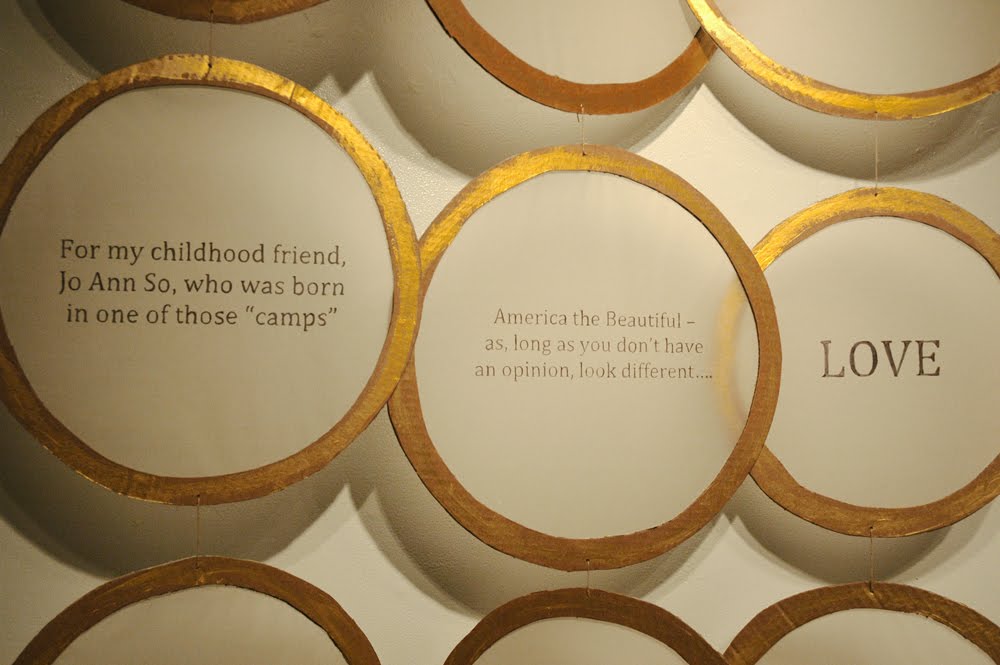
This piece by Reiko Fujii is particularly moving. Japanese American who experienced internment in camps in the spring of 1942 (the last camp closed in 1945), are invited to write a note on a tag and to attach it to one of the poles of the installation. Between the poles a clothe line displays clothing used by the deported families.


Some of the tags


Judy Shintani, Bottom Drawer, 2009
24x10x5 in., roots, photos, drawer.
"There are so many questions I am not able to ask my grandparents. They left this world before I knew what I wanted to know. How was it for them to leave their birth country? What was their internment experience? Unknown history, stuffed in the dark tangles of the bottom drawer. " Judy Shintani
Some past events of the American history are still difficult to talk about today (true for any country I guess, including France where I come from: the Algerian war is still a very sensitive subject for example). Bad decisions are made and the consequences are huge for the following generations. The hope is to be able to share, to discuss and finally to heal. That's why a show like this is very important.
Distillations: Meditations on the Japanese American Experience
Reiko Fujii, Lucien Kubo, Shizue Seigel, and Judy Shintani
John F. Kennedy University
2956 San Pablo Avenue, 2nd Floor
Berkeley, CA 94702
admission: free
Subscribe to:
Posts (Atom)