My blog has moved!

You should be automatically redirected. If not, visit
http://www.micheleguieu.com/wordpress/inspiration/
and update your bookmarks.

Pages

Thursday, August 25, 2011

Back from a road trip to Yellowstone and Grand Teton National Park - Day 5 & 6


Yellowstone - Canyon Village (elevation 8000 feet). We did a loop hike, which took us most of the day with all the stops. We took our time, we enjoyed the different landscapes the trail goes through. Uncle Tom's Point, Clear lake (an hydrothermal area), Lili Pad Lake, Point Sublime, Artist Point, down to Uncle Tom's Trail and back to Uncle Tom's Point. Approximately 6 miles.
Starting in a meadow, then entering a forested area. At the crossing with Ribbon Lake Trail we saw this sign: the area was closed due to bear activity. We felt a little bit alone there - we haven't seen anyone on the trail yet.


Lily Pad Lake was very quiet. Only a few mosquitoes came out of the shade when we arrived. We talked to a ranger who was hiking with a group and asked her about the closed area due to bear activity, she said it was also because they just discovered a wolf's den and they did not want the animals to be disturbed.


Then the trail arrives on the South Rim of the Grand Canyon Yellowstone River and we started seeing more people. The rim along the trail is a sheer cliff and the landscape totally breathtaking, and my mind was battling between worries and awe..


We saw lots of these signs.


View of the massive Lower Falls from the South Rim trail, going to Uncle Tom's Point.


And from the end of the Uncle Tom's trail: 300 steps down (500 feet) from the rim trail.


Getting back up the 300 steps, strenuous at 8000 feet! 


Norris Geyser Basin, a few miles West of Canyon Village. This really feels like we - humans - do not belong there but it is amazing to have the possibility to watch it.


The surprise of the geysers. Some are predictable: the rangers in some places even post possible "eruption windows" for the day "may erupt between 10 am and 2 pm", which seems pretty unreal. A prediction is based on the time of the previous eruption. Some are not predictable, some stop erupting all together, some new ones appear.
I felt like I was walking on the lid of a giant boiling pot and that it could explode anytime. At the same time the fascination and the sight were so powerful, that it was almost impossible to leave the place.


The thermal activity can kill the trees around and the chemicals make them look like they wear white socks.


The following day, a more familiar type of landscape! Sweet hike to - and around - Trout Lake in Lamar Valley. We had lunch watching a happy otter.


Lamar Valley - Pebble Creek (close to the North East entrance of the park). Another traffic jam. Cars stopped, ranger on duty: something is going on. We have the time to see... the back of a bear above the high grass. We park the car and our neighbor tells us that a grizzly has been seen in the meadow for two days now. Which explains the presence of the ranger: a ranger comes if a grizzly is close to a road, mostly to tell people to stay away. The bears look fuzzy, round and nice, people forget they are wild animals and they want to get close.
The grizzly showed up again, walking slowly and eating plants. When it got 40 yards away from the car, the ranger asked us to get back inside.


The grizzly (an adult male according to the ranger), was magnificent and seemed to enjoy very much the plants he found around there.
There are approximately 150 grizzlies in the vast Yellowstone Park and I wonder how it is even possible to see a grizzly given the odds...


We drove West to Mammoth Hot Springs that evening, via Tower Roosevelt and saw quite a lot of these sights: the "new forest" and the dead trees still standing in the middle of it. It may be the 1988 fire, may be a more recent one. But where the forest burnt, it is regrowing strong and thick.

Wednesday, August 24, 2011

From Guieu to Sigg


Just before leaving for Yellowstone, I sent an image to Ivan and his family.

Back from a road trip to Yellowstone and Grand Teton National Park - Day 3 & 4


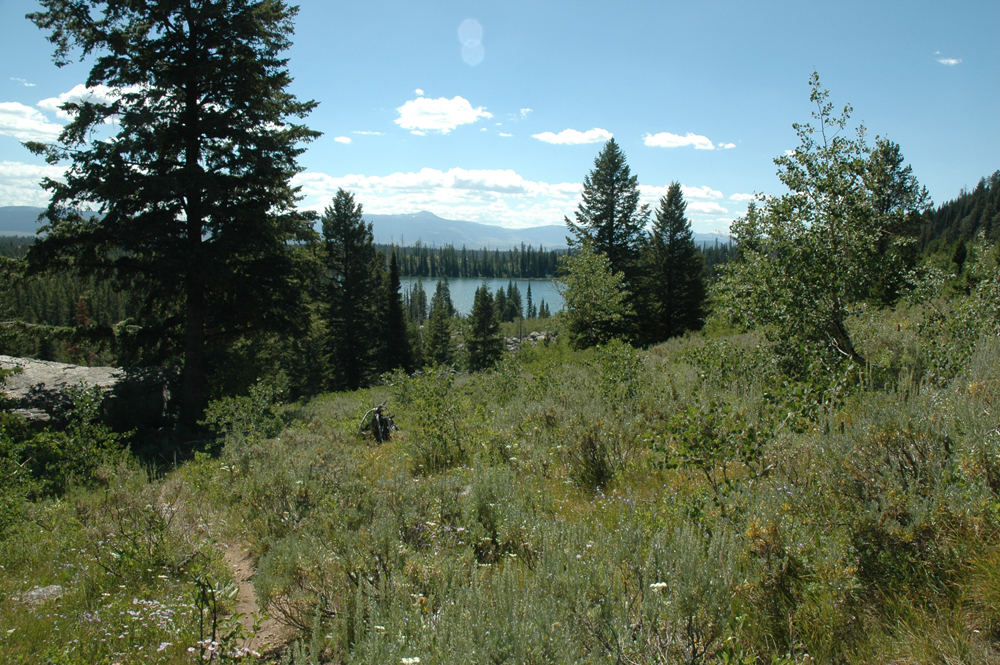
Grand Teton. In the crisp morning air, we did the trail around String lake after driving a few miles South of Colter Bay.


Passage between Spring Lake and Leigh lake.


Perfect habitat for bears.
We came across a small group of hikers who told us that they just saw a black bear and her two cubs on the trail. They made some noise to make them go away a little. We did not see the bears, not sure we wanted to. Everyone we've met while hiking had a bear spray at hand. I do not know if it is because of the deadly attack by a grizzly in Yellowstone last July, or if it is a common thing. We bought one too. The spray does not harm the bears but it helps in difficult situations.

On that trail we did not see a lot of people anyway. That's one interesting fact about the National Parks. They have lots of visitors each year and specially in the summer. But once one leaves the Visitor Center and the main overlook stops that are accessible by car, one already lost 95% of the crowd.
And so hiking is really amazing, the feeling of being almost alone in a pristine nature is fantastic - but there are the bears of course. And I was thinking about them!

Canoeing on quiet Jackson lake at the end of the afternoon (We rented the canoes at the marina). We saw a bald eagle perched on top of a tree, signaling all the other birds that it was a taken territory.


After a second night in our cabin, we drove a few miles south to get an early breakfast at Jackson Lake Lodge before going on a "Scenic Snake River float trip". The waitress was from Eastern Europe, I do not remember the country. Lots of young people come from all around the world to work in the National Parks for the summer.


Checking out the animal sighting notebook at the lodge.


The float trip on Snake river was great and tranquil. We saw several bald eagles. The raft was not full, only 10 people.
Although the park seems pretty busy in some places, our guide says that the average time a visitor spends in the park is an hour and half. That's because the majority of visitors go through Grand Teton on their way to Yellowstone and do not stop


A black bear on the side of the road. Photo taken from the car.


Arriving in Yellowstone. I like the signage. I took lots of photos of road signs and park signs during this trip.


Crossing the continental divide, a line I've heard about since I was a little girl. "Ligne de partage des eaux" (continental divide), "derive des continents" (continental drift), "tectonique des plaques" (tectonic plates) were terms I was hearing very often in my house, terms about gigantic geological events that I could not comprehend, even with the explanations my father was giving to me.


Arriving in West Thumb Geyser Basin site, a thermal area on the shore of Yellowstone Lake. First encounter with the volcanic activity present underneath the surface of the ground.

Smoking and breathing landscape.

The strong smell of rotten eggs. Wet and warm fumes charged with sulfur all around us.
We walked on a boardwalk which goes around the site. It would be dangerous to walk close to the pools of boiling water: the crust can be super thin and break.


I did not witness it but apparently some people throw things in the pool. I do not understand the need people have to do that. Everywhere in the world. Mostly coins.


Each hot spring has a name: Fishing Cone, Big Cone, Twin Geyser, Blue Funnel Spring, Ephedra Spring...


First turquoise pool, a boiling Caribbean dream!
Here's the boardwalk, which allows to enjoy the site with some people around, but nobody in front.


In Mud Volcano site, North of Lake Village. The holes and pools make all sorts of noises. Gargling, bubbling, whistling... The liquids take different appearances, clear, murky, thick and have different colors.


A yellow-bellied marmot enjoying the sulfur fumes... at Sulfur Caldron.


I could have stayed there for hours, watching the bison in the vast lush meadow.


On our way to Canyon Village, along the Yellowstone River, first traffic jam. We learned that it happens pretty often in Yellowstone. Animals cross the roads, cars stop both ways. The bison in this case seemed completely oblivious of the cars. They were taking their time to cross, the males making all sorts of guttural noises.


It was interesting to be so close to the herd, but I've taken this photo through the window. The park regulation is that people should not get closer than 75 feet from a large animal like a bison and 300 feet from bears and wolves, for safety and to leave the wild animals alone. Of course when the animals cross roads, close encounters happen, but being inside the car feels rather safe!

Tuesday, August 23, 2011

Back from a road trip to Yellowstone and Grand Teton National Park - Day 1 & 2


Coming back and having a hard time adjusting. I would have stayed there for much longer. I am always surprised by people telling me they are happy to be back home after a trip. I never feel that way.

I love road trips and when we planned to go to Yellowstone a few months ago, it did not take long to decide to drive up there and back. A 16 hours drive through California, Nevada, Idaho and Wyoming. It is really a cool thing to experience the distance, the space.


One of the reasons I first visited the U.S. was to hike in the National Parks in Utah, Colorado, New Mexico and Arizona. To get around one has to drive in the middle of immense desert landscapes which is part of the pleasure of traveling in the West.

Music, discussion, naps, silence. Sweet boredom.

Watching the shiny massive trucks, the bypassing Union Pacific freight trains.

Watching the changing landscapes: in the mountains going up to Tahoe, arriving in Reno and going through the golden Nevada desert for hours, going North to Twin Falls, Idaho, through much greener lands and then through more mountains crossing Wyoming and approaching Jackson.


The billboards, the road signs.


A night in Elko, Nevada, and not in a chain motel. Dinner at Sergio's, a small taqueria. Before the connection became almost non-existent (it was off an on through Nevada and Idaho), we used Yelp to find cool places to stop at, places that we could never had find before.


Stopping at Hansen Memorial Bridge, Twin Falls County, Idaho. In 1919, a high suspension bridge was constructed here, over the Snake River, and then replaced in 1966 by a new construction. Before 1919, there was only a rowboat to cross the river.


The pioneers who crossed the country encountered numbers of impassable gorges like this one. A gorge we crossed in a few seconds with our car.


Shortly after passing crowded Jackson (many people fly there and rent a car to go to Yellowstone), we arrived at the quiet south entrance of Grand Teton National Park and spent the night in Colter Bay village on Jackson Lake, in a cozy historic log cabin.

Some people engraved names and dates on the logs around the bed heads.

No phone and no TV in the cabin, no internet - except at the office, but we decided not trying to be connected for the rest of the trip. And that was good.

We left the few food items we had in the car, due to the presence of bears, and not only black bears. At the registration office, we were told that two female grizzly and their cubs, 5 animals in total, were in the close area.

But we felt more threatened by the mosquitoes which attacked us upon our arrival. We bought an insect repellent (all natural!) first thing the following morning at the general store.